Porcini Mushroom Art Print, vintage botanical illustration, woodland decor, nature lover gift, antique field guide style
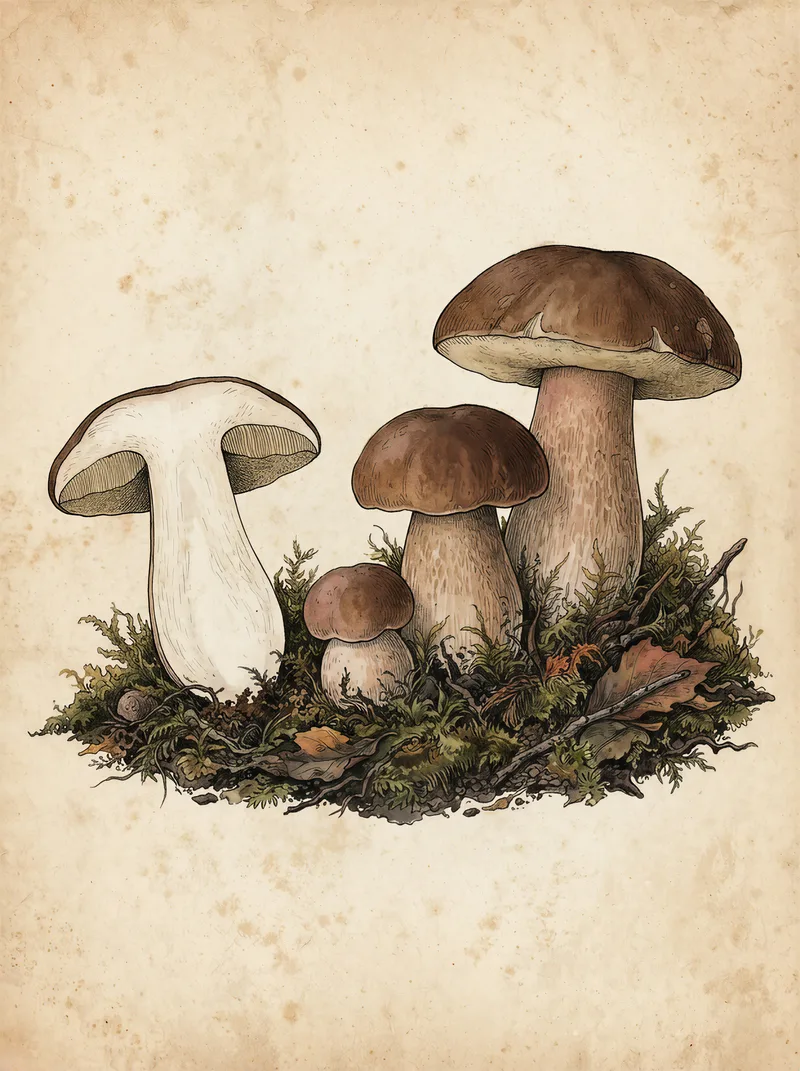
This art print presents several Porcini mushrooms at different growth stages, all rooted on one continuous mossy forest floor, with a sectioned specimen revealing its gills and stipe. Fine ink linework and soft gouache colour create an antique field guide feel on Enhanced Matte Paper (189 g/m²), with umber, moss green, ochre and dusty rose tones. A thoughtful gift for mushroom lovers or a woodland-inspired study.
For someone who keeps a field guide beside the kettle, notices fungi on woodland walks, or collects small reminders of the natural world, this Porcini Mushroom print makes a considered gift for a birthday, housewarming, or quiet seasonal occasion. It suits a mushroom lover, a gardener, a naturalist, or anyone drawn to the stillness of a forest floor. In a study, reading nook, kitchen, or cabin-style bedroom, it brings a touch of the outdoors without relying on bright colour or theatrical decoration. The antique field-guide character gives it a sense of observation and purpose, while the subject remains familiar and approachable: edible woodland mushrooms shown as specimens rather than as a pattern or a single isolated icon. It can mark an interest in foraging, mycology, botanical drawing, or simply the pleasure of looking closely at things that are easy to miss beneath the trees.
When it is unwrapped, the eye moves across one continuous patch of mossy ground, where several porcini appear at different stages of growth. Smaller rounded caps sit near fuller, weightier forms, creating a gentle change in scale from one side of the composition to the other. A cutaway specimen adds an inward view, showing the pale underside, the fine gill structure, and the sturdy stipe beneath the cap. Fine ink lines define the edges, folds, stems, and uneven forest textures, while soft gouache fills the forms with umber brown, moss green, muted ochre, and dusty rose. The colours stay earthy and slightly softened, like pigments in an old natural-history volume. Against the matte surface, the drawing retains a quiet, tactile quality: you can follow the contour of a cap, see where the moss gathers around each base, and notice the contrast between the solid mushroom shapes and the loose marks of the ground.
Over time, the print works as a steady point of detail in a room rather than something that demands attention from across it. In a neutral space, its brown and green tones can sit alongside oak, walnut, linen, woven baskets, stoneware, or aged metal. In a more colourful room, the ochre and dusty rose can echo cushions, ceramics, dried grasses, or painted wood without requiring an exact match. Hang it near a desk to accompany reading and sketching, above a sideboard with other nature studies, or among framed maps, pressed-plant forms, and woodland photographs. Its subject gives visitors something to look at closely, while the single forest-floor setting keeps the composition grounded. As furniture, textiles, and surrounding artwork change, the restrained palette remains easy to work around, allowing the mushroom study to continue feeling at home through different seasons and room arrangements.
“An antique field-guide study of Porcini at varied growth stages, rendered in ink and soft gouache for a naturalist's wall.”
- SubjectSeveral Porcini specimens at varied growth stages, one sectioned to reveal gills and stipe.
- Palette & lightMoody woodland tones of umber, moss green, ochre, and dusty rose on warm aged paper.
- CompositionContinuous mossy forest floor anchors all specimens, with fine ink linework and subtle mottling.
- Where it fitsSuits a kitchen corner, forager's pantry, reading nook, or gift for a mycophile.
| Material | Enhanced Matte Paper (189 g/m²) |
| Digital printing | |
| Care | Frame or mount out of direct sunlight; wipe gently with a dry, soft cloth. |
| Shipping | Made to order — ships in 2–5 business days |