Shaggy Ink Cap Mushroom Study II Art Print, vintage botanical illustration, woodland decor, nature lover gift
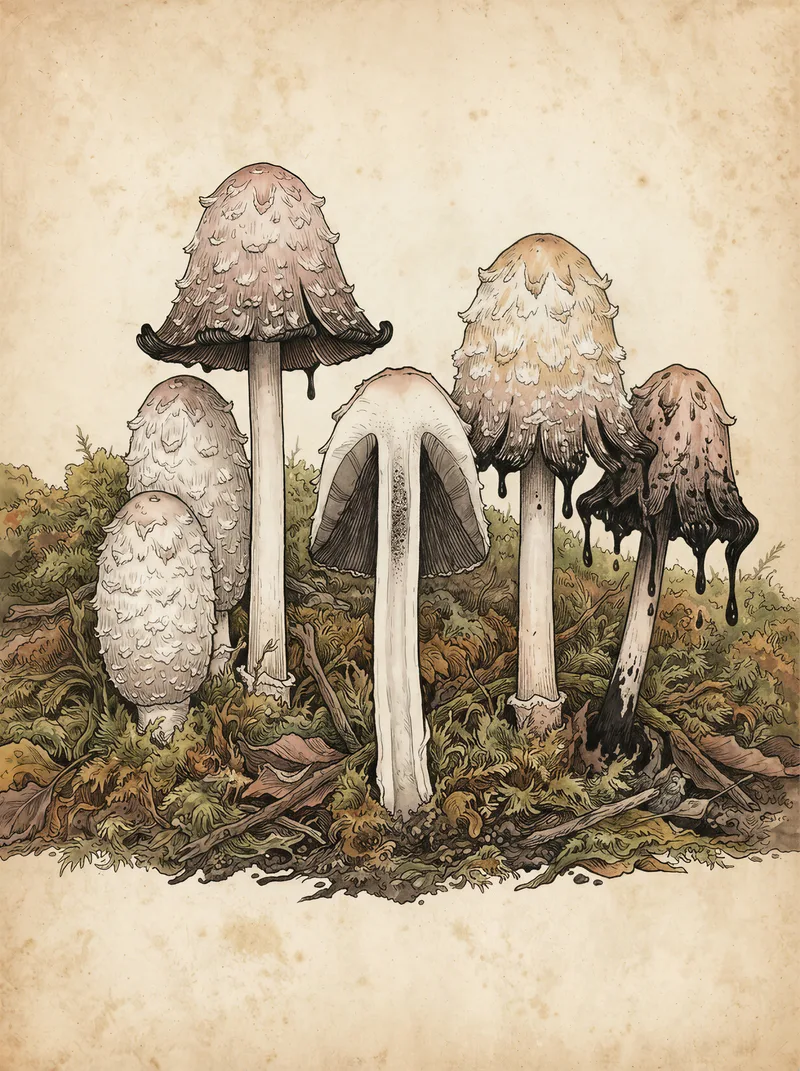
This vintage mycological art print depicts Shaggy Ink Cap mushrooms at several growth stages, rooted together on a continuous mossy forest floor. Fine ink linework, soft gouache colour, and a lengthwise section revealing the gills create an antique field-guide feel on Enhanced Matte Paper (189 g/m²), with umber, moss green, ochre, and dusty rose tones. A considered gift for mushroom enthusiasts and nature lovers.
The eye meets a small woodland study arranged across a single, continuous patch of forest floor. Shaggy Ink Caps rise in a loose cluster, with younger forms close to the moss and taller caps opening above them, so the composition reads from the ground upward. One mushroom is shown lengthwise, its interior exposed to reveal the closely set gills, while the surrounding specimens remain whole and rooted together. Fine ink contours describe the frilled edges, slender stems, folds, and uneven ground with the precision of a field sketch. Soft gouache fills the drawing without covering that linework: umber gives the caps and earth a warm, worn depth; moss green settles through the ground; ochre catches the older, drier passages; and dusty rose adds a muted note to the mushroom flesh. The restrained palette leaves room for the white space around the forms and gives the image the quiet, observant character of a study made outdoors rather than a decorative pattern.
Its visual language belongs to the tradition of botanical and natural-history plates, where a single image could record a species at several stages and make close looking part of the experience. A concrete marker of that tradition is the way the mushrooms are presented together as specimens: the clustered growth, the changing cap shapes, and the cutaway view all sit on the same ground so their differences can be compared at a glance. The ink-and-gouache method reinforces that reference. Ink establishes the descriptive structure, while thin, softly placed colour separates cap, gill, stem, moss, and soil without turning them into flat blocks. The result has the measured feel of an old mycological guide, but it remains easy to live with as a wall image. It will suit a room where natural forms, collected objects, and quiet details already have a place, whether that is a reading corner, a study, a hallway, or a bedroom with woodland-inspired decor.
Hang it where the light is gentle enough to keep the fine lines legible: beside a north-facing window, on a wall opposite a bright opening, or beneath warm evening lighting. Daylight will bring out the moss green and ochre, while lower, warmer light will draw attention to the umber ground and dusty rose accents. A pale plaster wall or warm white background will give the darker stems and caps clear definition; olive, clay, taupe, or muted brown surroundings will make the print feel more embedded in a forest palette. Place it near a wooden shelf, a ceramic vase, field guides, pressed leaves, or other natural materials for a considered botanical corner, or let it stand alone where its vertical growth and detailed section can be read from across the room. It offers a specific connection to fungi without becoming overly rustic, making it a fitting choice for a mushroom enthusiast, gardener, woodland walker, or anyone drawn to the quiet structure of the natural world.
“A field-guide study rewarding close looking, with layered growth stages, a sectioned gill view, and earthy woodland hues lending scholarly charm.”
- SubjectSeveral Shaggy Ink Cap mushrooms at varied growth stages, one sectioned lengthwise to show gills and stipe.
- Palette & lightMoody woodland tones of umber, moss green, ochre, and dusty rose on aged warm paper with foxing.
- CompositionAll specimens share one continuous mossy forest floor base, anchoring the study along a single plane.
- Where it fitsA reading nook, kitchen, or gallery wall where its botanical detail invites quiet, lingering study.
| Material | Enhanced Matte Paper (189 g/m²) |
| Digital printing | |
| Care | Frame or mount out of direct sunlight; wipe gently with a dry, soft cloth. |
| Shipping | Made to order — ships in 2–5 business days |