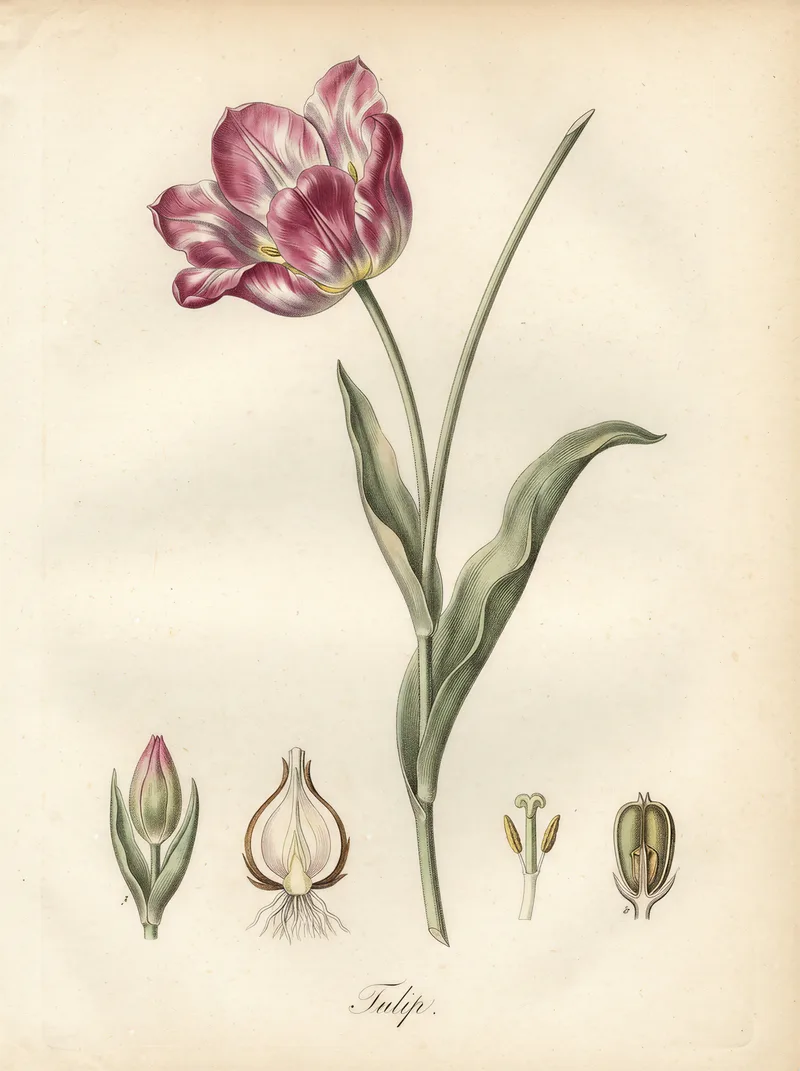
Tulip Art Print, hand-coloured botanical engraving, French atlas style, study room decor, gift for plant lovers
A hand-coloured stipple engraving of a single Tulip stem creates a refined botanical study, with precise linework, fine cross-hatching, translucent watercolour washes, and neatly spaced dissection details beneath. Printed as an Art Print on Enhanced Matte Paper (189 g/m²), it brings an early 19th-century French atlas character to a study, hallway, or thoughtful gift.
The eye meets a single tulip stem set against a quiet ground, its upright form balanced by gently bending leaves and the rounded geometry of the flower. Fine ink-grey linework defines the stem, veins, petals, and edges, while close stippling gives the bloom a softly textured surface. The palette is restrained: leaf green, muted rose, warm red, pale cream, and touches of ochre sit together without overpowering the delicate drawing. Beneath the plant, small botanical sections are arranged in an orderly row, creating a second rhythm of circles, curves, and cut forms. Cross-hatched shadows and light watercolour washes keep the image precise yet tactile, like a page made for close looking rather than a distant decorative pattern. The open space around the stem allows the silhouette to remain clear, whether viewed from across a room or from a chair beside a desk.
This style belongs to the early 19th-century French tradition of illustrated botanical atlases, where plants were recorded as both living forms and subjects for careful study. Its defining marker is the combination of a complete specimen above with neatly separated dissection details below: the flower can be appreciated at a glance, then examined through its smaller structural parts. Stipple engraving builds tone from fine dots, while cross-hatching gives depth to the leaves and stem with a measured, almost architectural consistency. The hand-coloured washes add distinctions that line alone cannot provide, separating the green foliage from the warmer tulip bloom and bringing a quiet sense of dimension to each component. It has the character of a classical study plate without feeling distant or purely technical, making room for the pleasure of the flower as well as the discipline of its observation. In a study room, it can sit naturally among books, wooden furniture, ceramic vessels, and other objects chosen for their form and usefulness.
The print suits walls where daylight is gentle and indirect: beside a north-facing window, above a writing desk, or along a hallway that receives soft morning light. Its pale ground and measured colour range work well with white plaster, warm grey, olive, muted blue, or natural wood, while the vertical composition fits comfortably in a narrow space or as part of a group of botanical plates. In stronger afternoon light, the quieter washes can become a calm counterpoint to the room’s brighter surfaces; under a reading lamp, the fine dots and hatch marks invite a closer view. Hang it in a study for a focused, collected atmosphere, in an entryway as a small visual pause, or in a bedroom where the stem’s upward movement adds a simple organic note. It also makes a considered gift for someone drawn to plants, vintage scientific illustration, French atlas pages, or the combination of decorative colour and exact observation.
“A quietly authoritative botanical plate that lends scholarly grace to a desk, study shelf, or reading corner.”
- SubjectSingle tulip stem with bud, seed, and cross-section dissections arranged neatly below.
- Palette & lightTranslucent rose, coral, and sage washes over warm ivory laid paper, softly luminous.
- CompositionOne large stem fills the upper two thirds, with a precise row of dissection details along the bottom.
- Where it fitsReading nook, study, or home office where quiet, considered detail is welcome.
| Material | Enhanced Matte Paper (189 g/m²) |
| Digital printing | |
| Care | Frame or mount out of direct sunlight; wipe gently with a dry, soft cloth. |
| Shipping | Made to order — ships in 2–5 business days |